Older Tarrant County housing stock in Fairmount, Arlington Heights, and Oakhurst relies heavily on elevated pier-and-beam foundations. These wood floor assemblies sit directly over native clay soil that expands and…
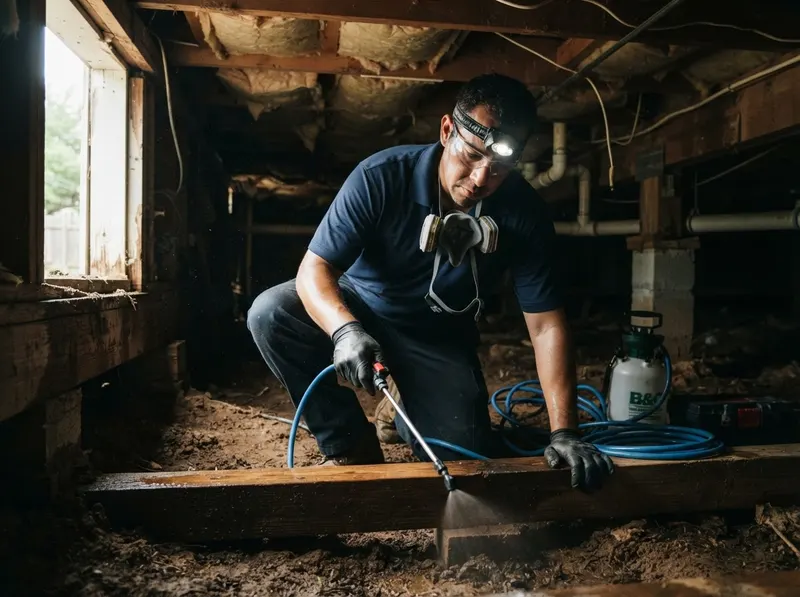
Older Tarrant County housing stock in Fairmount, Arlington Heights, and Oakhurst relies heavily on elevated pier-and-beam foundations. These wood floor assemblies sit directly over native clay soil that expands and holds water during seasonal North Texas rain events. When relative moisture levels inside an unsealed crawlspace exceed 20 percent wood moisture equivalent (WME), wood-decay fungi soften cedar and pine support timbers. This damp microclimate draws subterranean termite colonies from the soil upward into subfloor framing, while American roaches and brown recluse spiders nest along the perimeter grade beams. Remediation stops this cycle by replacing chemical aerosol spraying with soil vapor encapsulation and permanent exterior entry exclusion.
Subfloor moisture management requires distinct technical solutions based on the condition of the crawl foundation. If an under-floor space measures above 19 percent wood moisture but retains functional perimeter wall vents, 12-mil polyethylene ground covers combined with 1/4-inch galvanized steel mesh over vent openings successfully resolve pest ingress without mechanical equipment. If persistent low-grade soil water accumulation occurs along Trinity River drainage areas near Tanglewood and TCU-Westcliff, closed crawlspace encapsulation paired with an under-structure dehumidifier and a 0.50-horsepower sump pump becomes necessary. The operational trade-off centers on upfront mechanical costs versus long-term wood replacement: a passive vapor barrier carries lower upfront investment but cannot lower air humidity when exterior dew points remain above 72 degrees Fahrenheit during humid August stretches in Fort Worth.
Technicians conduct an entry-to-vent inspection measuring pier spacing, subfloor joist moisture, and clearance depths, which often drop below 18 inches in historic Fairmount cottages. Step one involves clearing rotted organic debris and cellulose materials that act as primary food attractants. Step two installs high-puncture tear-resistant poly barriers across exposed dirt, fastening material 6 inches above the interior grade line with masonry pins. Step three applies non-volatile, zero-odor disodium octaborate tetrahydrate (DOT) directly onto structural sill plates and band joists, rendering timber toxic to wood-boring insects while remaining inert for dogs and children inside the living quarters above. The work completes by sealing plumbing penetrations and rim joists with expanding closed-cell foam to halt rodent travel pathways.
Every job gets a firm, written price after a free on-site visit.
Tell us about your crawlspace and pier-and-beam moisture pest remediation job in Fort Worth and we'll send a clear, written quote, usually the same day.
 HomeShielders Pest Control